How Much Space Should You Leave Between a Kitchen Island and Units?

By

4 min read

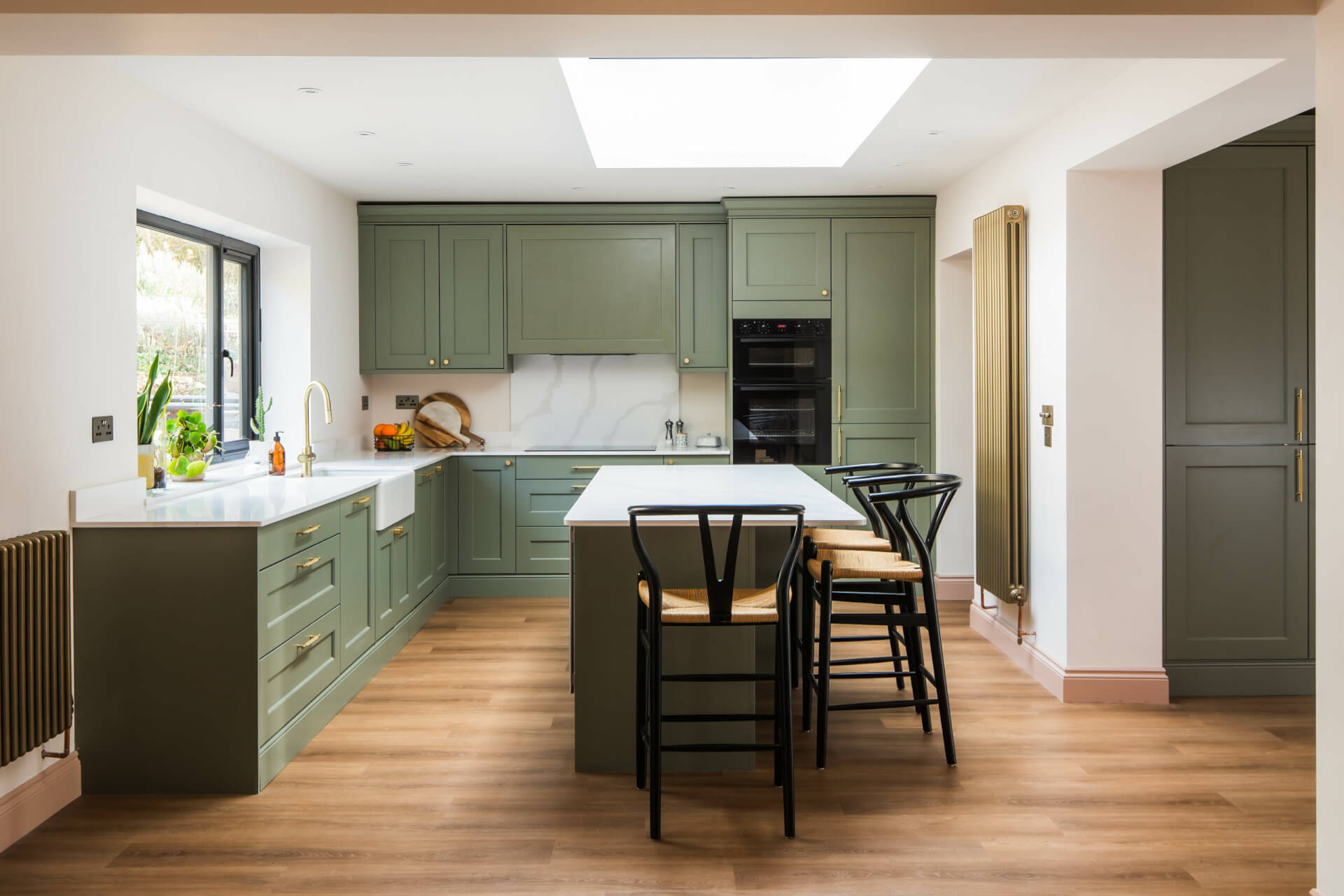
The ideal distance between a kitchen island and the surrounding units is typically 1 metre as standard, with 1.2 meters also considered reasonable.

Contents

1. Introduction: How Much Space Should You Leave Between a Kitchen Island and Units?
2. Key Takeaways: Designing Gaps Between a Kitchen Island and Units
3. Why Is the Spacing Around a Kitchen Island So Important?
4. What Considerations Matter When Planning Kitchen Island Placements?
5. Quick Guide to Suggested Minimum Clearance Space Around a Kitchen Island
6. What Is the Issue With Leaving Too Much Space Between Kitchen Islands and Units?
7. Frequently Asked Questions

Request Our Kitchen Brochure

Having the right amount of clearance ensures everyone can move around the kitchen safely, cook comfortably, and access appliances and cabinets without leaving too little space that makes a room feel cramped and awkward.  Too large a gap between the kitchen islands and units can seem disjointed and inefficient.

While the specific spacing will always depend on having a balance between ergonomics and proportions, it’s important to get this right, as layouts have a huge impact on how enjoyable a new kitchen is to use every day.

Designing Gaps Between a Kitchen Island and Units: Key Takeaways

  • Generally, it’s best to leave at least one metre of clearance between islands and worktops to create enough space to move between surfaces or walk around a kitchen island.
  • Most designers suggest up to 1.2 metres of clear space to maximise usability, without having units crammed together or leaving tight gaps that families can only pass through one at a time.
  • Leaving too much space is just as much of a design error as having an island too close to the cabinets, making it awkward to reach items from the fridge or utensils from the cabinet.

Why Is the Spacing Around a Kitchen Island So Important?

Kitchen islands are often focal points, positioned in the centre of the room and providing a place for preparing ingredients, sitting down to chat, or storing food and other items – but the space surrounding them influences how the kitchen flows and feels.

As one of Smile Kitchens designers commented, ‘Islands aren’t solely functional, because they’re also spatially central and social areas, and having poorly designed spaces has an impact on both aspects.

Think of an island like the equivalent of a traditional farmhouse kitchen table, and the relevance becomes clear – because having a table tucked against a wall where half of the seats are blocked off or located right in the middle of the room simply wouldn’t work.’

What Considerations Matter When Planning Kitchen Island Placements?

From a practical perspective, spacing affects the distance between cooking zones and storage, the safety of a kitchen when the person cooking is handling sharp knives or hot dishes, and the clearance for oven, dishwasher, and fridge doors.

However, it’s also about comfort: you need to ensure the seating around an island is accessible and that the kitchen is visually well-balanced. Here are some of the aspects to keep in mind:

1. Kitchen Size and Layout

Kitchen islands only make sense when the room has the capacity for this extra feature, and as a rough rule of thumb, homeowners need:

  • A kitchen of at least four metres x four metres
  • An open-plan kitchen design

If neither applies, or it would be a squeeze to install an island with sufficient clearance, it might be better to go with a peninsula instead.

2. Number of Users or Household Members

Homes where multiple people cook simultaneously or spend time in the kitchen together need more room around the kitchen island, because one metre is probably sufficient for one cook, but around 1.2 metres or more will be appropriate for family cooking.

Entertaining spaces within kitchens also need to be accounted for, having walkways that are wide enough to walk through without knocking anything aside.

3. Location of Appliances

During the design phase, homeowners need to be clear about where appliances will be installed, including ovens, dishwashers and fridges. Plotting these items and measuring the doors’ dimensions ensures that islands can be fitted in the right spot without affecting their use.

4. Access to Storage

Kitchens with extra-deep drawers or pullout storage need to be incorporated into design planning, as with appliances, with extra swing space so drawers can be opened fully without being obstructed by a kitchen island. Drawers and pull out storage improves access and maximises capacity, these options are fast becoming more popular than the conventional kitchen cupboard because of their advantages.

Quick Guide to Suggested Minimum Clearance Space Around a Kitchen Island

Clearance Available Functionality Best For
Under one metre Restrictive Very small kitchens, though an island might not be ideal
One metre Minimum safe clearance Single-cook kitchens
1.1 – 1.2 metres Recommended standard Most modern kitchen layouts
1.3 – 1.4 metres More comfortable, efficient kitchens Family and open-plan spaces
1.5 metres and above Potential to feel disconnected Only works in very large spaces

What Is the Issue With Leaving Too Much Space Between Kitchen Islands and Units?

Spacing works both ways – and as the above table indicates, when the distance from the island to the kitchen units reaches 1.5 metres and above, that can mean that:

  • The kitchen becomes inefficient for cooks trying to fetch items and ingredients from different surfaces and work zones.
  • Cooking takes longer, or very quick tasks – like shifting a hot pan or kettle – become potentially dangerous because you have to walk farther.
  • Kitchens can feel a little like two separate rooms that have been slotted together, since a larger clearance area can be visually odd.

Working on the practicalities of cooking, the enjoyment of entertaining and how close together specific features are – such as sinks and cookers – can help ensure that alignment is just right.

Frequently Asked Questions

What Distance Should Homeowners Leave Between Cabinets and Kitchen Islands?

Although the exact layout will always depend on the dimensions of the room and factors such as the size of the island and proximity to appliances, the standard in kitchen design is to leave 1-1.2 metres.

Can I Place a Kitchen Island Closer to the Units Than One Metre?

We’d not recommend it because having less than 100 cm of space between a unit door and an island can make it difficult or impossible to open doors or drawers fully. It can also mean that only one person at a time can move through the kitchen, or there isn’t enough space to put stools or seats around the island. However we understand the space does not always allow for this, so we would advise testing the method first, why not draw out the space on the floor, using chalk or a paper template and see how the space feels, limited space doesn’t always mean this is not possible, it is just utilising the given space in the most effective way and at the end of the day, you know what works for you.

What Amount of Space Do You Need to Put Seating at a Kitchen Island?

Depending on your specific seating, you’ll typically need at least 30 cm of overhang plus clearance for stools to ensure family members and guests can comfortably sit at a kitchen island, without making it difficult for anybody to cook at the same time.